Cross-border Logistics Tracking: Connectivity Solutions for Countries Along the Route
Cross-border tracking devices face three constraints: usability, cost, and connectivity reliability. No single SIM works for all routes. This article outlines a route-segmented approach, prioritizing frequency verification, country-by-country compliance, and break-recovery data transmission. It compares connectivity solutions and fallback strategies across three scenarios: fixed routes, multi-country long-haul lines, and remote oceanic/desert regions.
No single eSIM covers all global routes. The practical approach is to design per route: align frequency bands and verify compliance first, then define the primary link, backup path, and failover channel. For cross-border tracking devices constrained by "can it work," "cost," and "reliability," selecting a network is essentially designing connectivity for a specific route.

Comparison of Three Routes
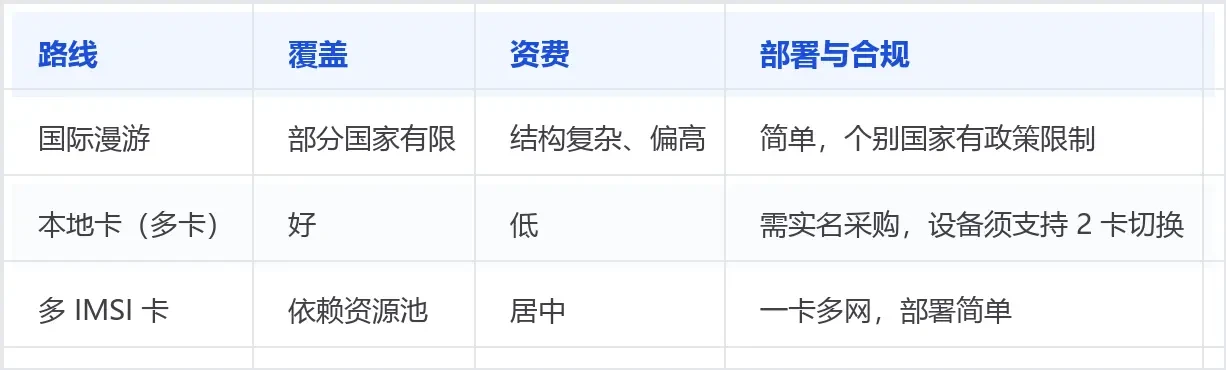
Three priorities that take precedence over the referral card
Band mismatch: Target country LTE band does not match module specifications; no signal will appear regardless of the SIM card used.
Country-specific compliance: Some countries require real-name registration and device certification; a few restrict long-term roaming.
Offline Resilience: In tunnels, mountainous regions, and border areas, connectivity drops are common. Devices must cache data locally and retransmit it in timestamp order once the connection is restored.
Use Cases and Limitations
Fixed route: Primary local SIM; roaming or multi-IMSI as backup for transit segments.
Multi-region long-distance: The primary link transmits only location heartbeats (approximately 1440 per day); other data is cached locally.
Remote areas and deserts: Satellite short messages serve only as an alert fallback; transmitting full data via satellite is not cost-effective.
FAQ
Q1: Can one card work across multiple countries?
Multiple IMSI cards are supported, but coverage depends on the carrier resources available.
Q2: What should I check first if there's no internet connection abroad?
Check the frequency bands first, then verify local compliance. Complete both steps before swapping the SIM card.
Q3: How do I verify a cross-border IoT SIM card?
Measure actual line segments directly; do not rely on advertised coverage maps.
Need global IoT SIM pricing comparison or selection advice?
Tell us your target country and device usage, and we'll compile the corresponding pricing plans and recommendations for you.