Slow drone data uplink? Uplink bandwidth is the bottleneck.
Video transmission lag is rarely caused by slow download speeds; it's usually due to insufficient upload bandwidth. Cellular networks have asymmetric uplink/downlink resources, and in congested areas, uplink capacity can be further consumed by other mobile users. This article breaks down the four bottlenecks in backhaul latency, outlining the trade-offs and limitations of four optimization strategies: multi-SIM aggregation, compression and bitrate reduction, edge offloading, and strategic site selection. It also explains why swapping SIM cards won't increase uplink capacity and how to set bitrates based on real-world measurements.
Most transmission lag stems from insufficient uplink bandwidth. Cellular networks have inherently asymmetric uplink/downlink resources; since video streaming relies entirely on the uplink, a standard speed test won't reflect the actual issue. Base stations allocate resources based on an uplink/downlink ratio, meaning uplink capacity is often just a fraction of the downlink's. In congested cells, this limited uplink is further shared with other mobile users.

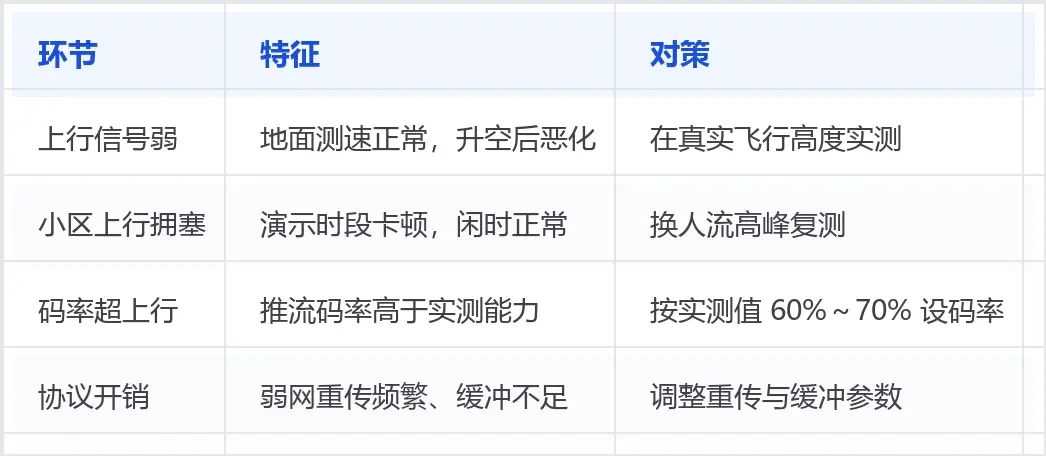
Troubleshooting the Four Stages of Slow Data Backhaul
Inbound & Restrictions
Multi-card aggregationMulti-link aggregation with redundant backup increases cost and power consumption.
Compress and downgrade: H.265 compression; automatically reduces resolution and frame rate under weak network conditions instead of dropping the stream.
Edge offloadingStore original files locally and upload them back after storage.
Select Point: A clear takeoff point facing the base station significantly improves uplink performance.
Uplink is a scarce resource at the base station; devices can only optimize its usage, not create bandwidth. Solutions must be grounded in empirical measurements.
FAQ
Q1: Why is my drone laggy even though my phone shows fast internet speeds?
The phone measures downlink, while the video link uses uplink—they operate on completely different scales.
Q2: Will switching to a different IoT card resolve the issue?
Swapping cards won't increase upstream capacity; the key is matching actual measurements with bitrates.
Q3: What bitrate is recommended?
Actual upload bandwidth is 60%–70%, with headroom for jitter.
Need global IoT SIM pricing comparison or selection advice?
Tell us your target country and device usage, and we'll compile the corresponding pricing plans and recommendations for you.
Related Reading
- Why does SIM-card removal trigger service suspension? First, understand the IMEI binding chain.Tech News · 2026-11-13
- How to choose an international IoT SIM card? eSIM, SMD packaging, and data pooling are three different things.Tech News · 2026-11-13
- International IoT SIMs Through the "Six Networks": Three Connectivity Hurdles for Overseas DevicesTech News · 2026-10-30